
Do New Zealand Politicians’ Words Align with International Law Principles?
Blog post description.
Anthonie Van Bosch
10/3/20253 min read

By Anthonie van Bosch
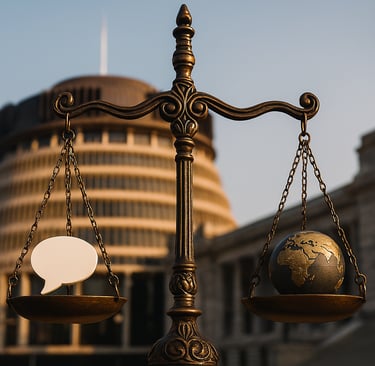
In Aotearoa New Zealand, political rhetoric is never just about domestic policy. The words spoken in Parliament often echo far beyond Wellington, resonating with international law principles that bind us as a nation. From treaty obligations to human rights, from environmental stewardship to fiscal responsibility, the language of our leaders can either reinforce or undermine New Zealand’s global commitments.
The Power of Political Speech
Political quotes are more than soundbites. They are signals — to voters, to communities, and to the international community. When a Prime Minister speaks about economic renewal, or when a young Māori MP invokes Te Tiriti o Waitangi, those words carry weight not only in local debates but also in the context of international law.
Indigenous Rights and Treaty Obligations
The most striking alignment with international law comes from Te Pāti Māori MPs. Hana‑Rawhiti Maipi‑Clarke’s maiden speech, for example, directly referenced Te Tiriti o Waitangi and the erosion of Māori rights. This is not just domestic politics — it’s a reminder of New Zealand’s obligations under the UN Declaration on the Rights of Indigenous Peoples (UNDRIP), which affirms the right to self‑determination, cultural survival, and participation in governance.
Similarly, Mariameno Kapa‑Kingi’s statement that “our people are not statistics” reflects Article 15 of the International Covenant on Economic, Social and Cultural Rights (ICESCR), which protects cultural identity. Tākuta Ferris’s insistence on being “unapologetically Māori” echoes Article 18 of UNDRIP, guaranteeing indigenous peoples a voice in decision‑making.
Environmental Stewardship and Intergenerational Equity
Takutai Tarsh Kemp’s reminder that “our mokopuna will judge us not by what we said, but by what we protected” resonates with the Paris Agreement and the principle of intergenerational equity. International law increasingly recognises that climate change is not just an environmental issue but a human rights issue, binding governments to act for future generations.
Human Rights and Empathy in Leadership
Former Prime Minister Jacinda Ardern’s emphasis on empathy as a leadership quality aligns with the Universal Declaration of Human Rights (UDHR), which enshrines dignity and equality as universal values. While not legally binding, the UDHR has shaped the moral and legal framework of international human rights law.
Economic and Social Policy
Quotes from Christopher Luxon and Nicola Willis focus on economic management and fiscal prudence. While not directly tied to international law, they intersect with the UN Sustainable Development Goals (SDGs), particularly Goal 16 on strong institutions and Goal 8 on sustainable economic growth.
Equality and Non‑Discrimination
James Meager’s assertion that “the left does not have a monopoly on Māori, on workers, or on the poor” touches on the principle of non‑discrimination, a cornerstone of international law enshrined in the International Convention on the Elimination of All Forms of Racial Discrimination (ICERD).
Conclusion
When we examine these quotes through the lens of international law, a clear pattern emerges: the strongest alignment comes from voices advocating for indigenous rights, environmental protection, and human dignity. These are not abstract ideals — they are binding obligations and moral commitments that shape New Zealand’s place in the world.
As citizens, advocates, and professionals, we should listen carefully. Political speech is not just about today’s headlines. It is about whether New Zealand honours its promises to its people and to the international community.
📚 Bibliography
United Nations. (1948). Universal Declaration of Human Rights (UDHR). Retrieved from https://www.un.org/en/about-us/universal-declaration-of-human-rights
United Nations. (1965). International Convention on the Elimination of All Forms of Racial Discrimination (ICERD).
United Nations. (1966). International Covenant on Civil and Political Rights (ICCPR).
United Nations. (1966). International Covenant on Economic, Social and Cultural Rights (ICESCR).
United Nations. (2007). United Nations Declaration on the Rights of Indigenous Peoples (UNDRIP).
United Nations. (2015). Paris Agreement.
United Nations. (2015). Sustainable Development Goals (SDGs).