Supermarket Competition Analysis: Australia vs New Zealand vs UK Executive Summary post
Anthonie Van Bosch
9/30/20256 min read
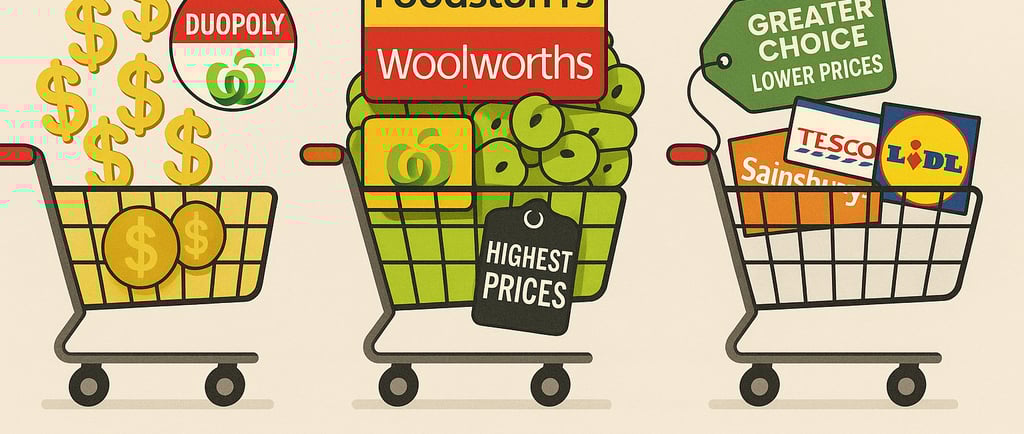
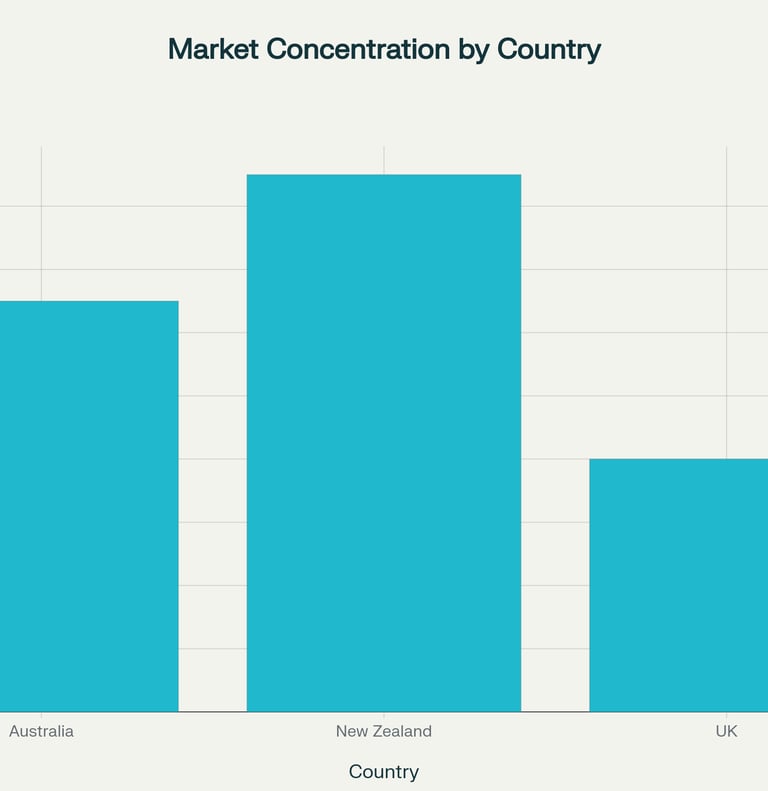
The investigation reveals stark differences in supermarket competition across the three countries, with New Zealand exhibiting the highest concentration and consumer harm, Australia facing an oligopoly with excessive profitability, and the UK maintaining the most competitive environment. New Zealand's virtual duopoly (85% market share) significantly exceeds Australia's concentrated duopoly (65%) and the UK's more competitive oligopoly (40% for top two players).
Market concentration comparison showing the combined market share of the top two supermarket players in Australia (65%), New Zealand (85%), and the UK (40%)
Market Structure and Concentration
New Zealand: Extreme Duopoly
New Zealand operates under a virtual duopoly between Foodstuffs (53% market share) and Woolworths (32.4% market share), collectively controlling 85-90% of the market. This represents one of the most concentrated grocery markets globally, with the Commerce Commission estimating a Herfindahl-Hirschman Index (HHI) of 3,601 in 2024, indicating extremely high concentration.
Australia: Dominant Duopoly
Australia's market is dominated by Woolworths (38% market share) and Coles (29% market share), together holding approximately 65-67% of the market. The addition of Aldi (9%) and Metcash/IGA (7%) brings the top four players to over 80% market control.
United Kingdom: Competitive Oligopoly
The UK maintains a more competitive structure with Tesco (28.4% market share), Sainsbury's (16%), Asda (13.4%), and Morrisons forming the "Big Four". The combined market share of the top two players is approximately 40%, significantly lower than Australia and New Zealand.
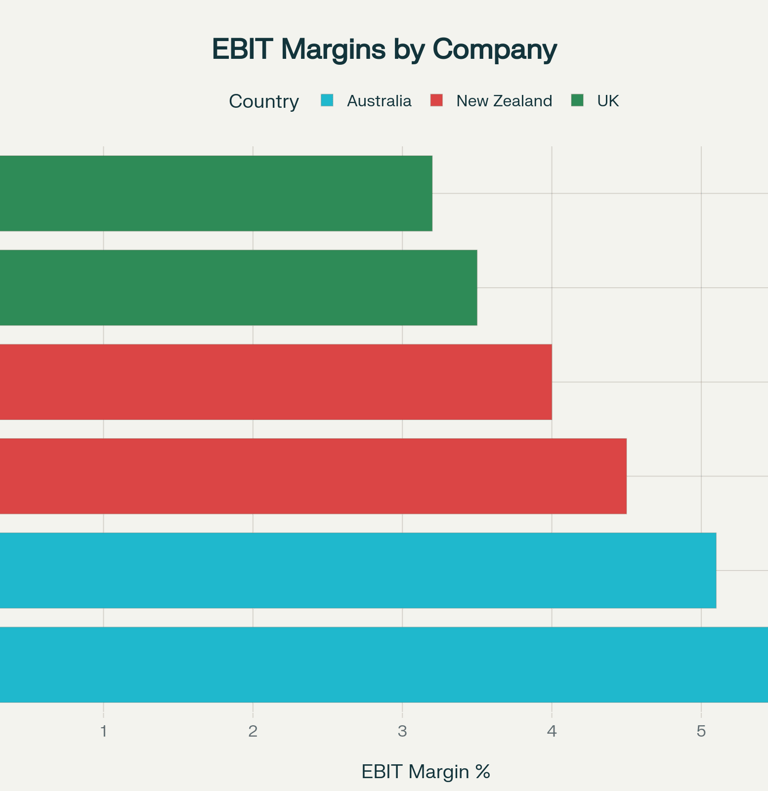
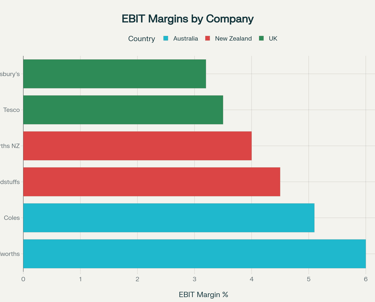
EBIT profit margins comparison across major supermarket chains in Australia, New Zealand, and the UK, showing Australian supermarkets achieving the highest profitability
Profitability and Pricing Analysis
Excessive Profit Margins
Australian supermarkets demonstrate the highest profitability globally, with EBIT margins of 5-6% for Woolworths and Coles, compared to 2-4% for UK supermarkets like Tesco and Sainsbury's. The ACCC found that "ALDI's, Coles' and Woolworths' EBIT margins are among the highest of supermarket businesses in relevant comparator countries".
New Zealand supermarkets maintain EBIT margins of 4-5%, while earning an estimated $430 million annually in excess profits between 2015-2019 due to limited competition.
Price Comparisons
Despite claims of competitive pricing, international comparisons reveal significant price variations. A standardized basket comparison shows:
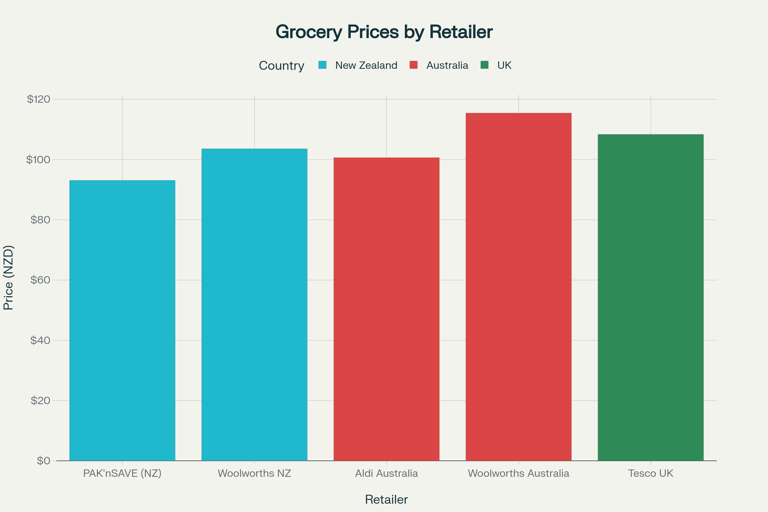
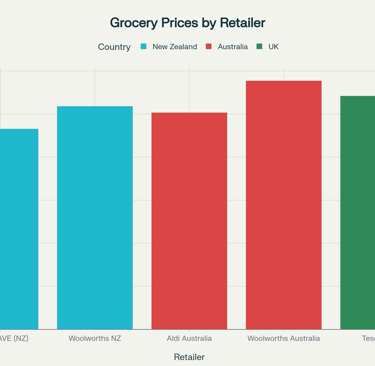
Grocery basket price comparison across retailers in Australia, New Zealand, and UK (in NZD), showing PAK'nSAVE as the most affordable option
Key finding: New Zealand's PAK'nSAVE offers the lowest prices at NZD $93.09, while Australian Woolworths charges the highest at NZD $115.44. However, these comparisons must account for GST differences, as New Zealand applies 15% GST to all food items while Australia exempts basic groceries and the UK has no VAT on most food products.
Regulatory Response and Reform Strategies
Australia: Competition Law Enhancement
Australia is implementing comprehensive merger reform with mandatory merger notifications from January 1, 2026. The approach focuses on:
Strengthening competition law with enhanced merger control and prohibition of excessive pricing
Mandating price transparency through APIs and price monitoring systems
ACCC inquiry powers with increased funding of over $30 million for enforcement
Designated transaction requirements specifically targeting supermarket acquisitions
New Zealand: Structural Intervention
New Zealand is pursuing the most aggressive reform approach, actively considering structural separation and divestment powers. The government has commissioned specialist advice on:
Potential de-merger of existing brands to create genuine competition
Structural separation of existing entities to fundamentally alter market dynamics
Enhanced wholesale regulation with penalties up to $10 million for breaches
Grocery Supply Code strengthening to address supplier-retailer power imbalances
Commerce and Consumer Affairs Minister Andrew Bayly stated: "If legislation is needed, I would want to introduce it before the end of the year and pass it during this parliamentary term, with rapid implementation shortly thereafter".
United Kingdom: Market-Based Approach
The UK maintains minimal regulatory intervention, relying on market-based competition and existing competition law. The Competition and Markets Authority (CMA) provides monitoring rather than structural intervention, reflecting the more competitive market environment.
Geographic and Access Inequities
New Zealand's Regional Monopolies
The Commerce Commission identified significant geographic inequities, with consumers in Auckland enjoying more competition (71% major supermarket share) compared to rural areas where supermarkets function as localized monopolies (88% market share outside main cities). Some rural areas have "minimal to no choice within their locality".
Australia's Widespread Reach
Australia maintains more consistent access, with both Woolworths and Coles operating extensive national networks. However, the duopoly structure limits genuine price competition across all regions.
UK's Diverse Competition
The UK benefits from diverse regional competition, with discount retailers like Aldi and Lidl gaining market share (Aldi reached 11.2% market share in 2025), providing genuine alternatives across different geographic areas.
Consumer Impact and Economic Consequences
Price Inflation Patterns
New Zealand recorded 1.2% annual food price inflation in September 2024, with Foodstuffs co-ops achieving 0.0% inflation for comparable baskets. However, grocery prices remain 3% above OECD average despite recent stabilization.
Australia experienced higher food price inflation of 3.4% annually, while the UK recorded 1.3%. The OECD noted that New Zealand's poor productivity rankings are partially attributable to "broken markets in sectors like banking and groceries, which make excess profits".
Consumer Behavior Changes
High grocery prices are driving significant behavioral changes:
69% of New Zealand shoppers now compare prices between supermarkets
Consumers increasingly shop at discount retailers and buy promotional items
PAK'nSAVE's market share growth reflects consumer price sensitivity
The Way Forward: Critical Reform Pathways
Australia's Comprehensive Legal Framework
Australia's reform strategy emphasizes strengthening existing competition mechanisms rather than structural breakup. The new mandatory merger regime specifically targets supermarket acquisitions, requiring ACCC notification for any supermarket transaction. This approach aims to prevent further concentration while enhancing price transparency through mandatory unit pricing and promotional disclosure requirements.
New Zealand's Structural Revolution
New Zealand is pursuing the most radical structural intervention, with potential legislation for mandatory divestment by late 2025. The approach recognizes that regulatory measures alone cannot address the fundamental market structure problems. As noted in legal analysis, divestiture would likely be favored by courts given the extreme concentration and lack of viable alternatives.
Effectiveness Assessment
The UK's competitive market structure demonstrates that lower concentration naturally results in better consumer outcomes without requiring extensive regulatory intervention. UK supermarkets operate with profit margins of 2-4% compared to 5-6% in Australia and 4-5% in New Zealand, directly benefiting consumers through lower prices and better service.
Conclusion
The UK emerges as the clear winner in supermarket competition, offering the lowest concentration (40% for top two players), most competitive pricing relative to income levels, and minimal need for regulatory intervention. New Zealand faces the most severe competition problems with its 85% duopoly requiring urgent structural intervention, while Australia occupies a middle position with high profitability concerns but more regulatory options for reform.
The evidence strongly suggests that market concentration directly correlates with consumer harm. New Zealand's consideration of divestment powers represents the most appropriate response to extreme market concentration, while Australia's enhanced competition law approach may prove sufficient for its less concentrated market. The UK's experience demonstrates that competitive markets can function effectively with minimal regulatory intervention when structural competition exists.
Success in grocery competition reform ultimately depends on creating genuine competitive tension—whether through the threat of divestment in New Zealand, enhanced merger control in Australia, or maintaining the competitive structure that already exists in the UK.
https://www.gourmetpro.co/blog/biggest-supermarkets-australia
https://www.statista.com/topics/8773/sainsbury-group-in-the-united-kingdom-uk/
https://www.equaljusticeproject.co.nz/articles/supermarket-duopoly-a-hunger-for-change2023
https://www.statista.com/topics/6399/supermarkets-and-grocery-retail-in-australia/
https://www.statista.com/statistics/280208/grocery-market-share-in-the-united-kingdom-uk/
https://uk.finance.yahoo.com/news/tesco-not-losing-grip-uk-104557136.html
https://www.accc.gov.au/system/files/supermarkets-inquiry_1.pdf
https://www.foodstuffs.co.nz/news-room/2025/PAKnSAVE-tops-international-grocery-price-comparison
https://www.landers.com.au/legal-insights-news/new-era-for-merger-control-in-australia
https://colemangreig.com.au/insights/publications/australias-new-merger-laws-from-1-july-2025/
https://www.beehive.govt.nz/speech/delivering-better-grocery-prices
https://ojs.victoria.ac.nz/vuwlr/article/download/9801/8623/16059
https://www.linkedin.com/pulse/uk-grocery-market-comparative-analysis-tesco-cem-buyukkaya-vuzwe
https://www.morningstar.com.au/stocks/this-household-asx-name-just-got-moat-upgrade
https://www.linkedin.com/pulse/numbers-oecd-grocery-prices-chris-quin-kq1vc
https://www.ernienewman.com/single-post/oecd-tables-possible-nz-supermarket-breakup
https://www.statista.com/statistics/1453348/australia-woolworths-supermarkets-by-state/
https://www.treasury.govt.nz/sites/default/files/2022-02/oia-20210006.pdf
https://www.ibisworld.com/australia/industry/supermarkets-and-grocery-stores/1834/
https://www.onefarm.co.nz/blog/an-answer-to-nzs-supermarket-duopoly
https://market.worldpanelbynumerator.com/en/grocery-market-share/great-britain
https://www.consumer.org.nz/articles/how-we-got-a-supermarket-duopoly
https://en.wikipedia.org/wiki/List_of_supermarket_chains_in_the_United_Kingdom
https://teachin.com.au/cost-of-living-in-the-uk-vs-australia--nz-and-canada/
https://www.hsfkramer.com/insights/2024-10/australian-government-introduces-merger-reform-bill
https://www.consumer.org.nz/articles/what-s-the-cheapest-supermarket
https://www.corrs.com.au/insights/the-new-accc-merger-regime-a-round-up-of-recent-announcements
https://www.consumer.org.nz/articles/australia-vs-nz-supermarket-competition-compared
https://www.accc.gov.au/inquiries-and-consultations/supermarkets-inquiry-2024-25
https://www.linkedin.com/pulse/facts-our-international-grocery-price-comparison-chris-quin-nmxkc
https://www.australiancompetitionlaw.info/reports/database/2024-2025-supermarket-inquiry
https://supermarketnews.co.nz/global/accc-releases-guidance-on-merger-reform-transition/
https://fisherfunds.co.nz/news-and-insights/supermarkets-dodge-governments-hospital-pass
https://www.accc.gov.au/business/mergers-and-acquisitions/merger-reform
https://www.accc.gov.au/business/mergers-and-acquisitions/merger-control-regime